
Micro-Habits and Habit Stacking: The Low-Effort Way to Beat Overwhelm and Build Real Routines
11 Dec 25, 09:50
Every year, millions of people (including me, probably including you) decide, “Alright, this is it. New habit. Fresh start.” And then… nothing happens.
Or more accurately: the habit lasts for about three days until your brain politely taps you on the shoulder and says, “Hey, buddy, this is way too much work. Let’s not.”
Most people fail not because they’re lazy or broken or hopeless. The real issue?
We set the starting line way too high.
You’ve probably said things like:
- “I’m going to work out every day.”
- “I’ll read 50 pages every night.”
- “I will live a perfectly optimized life starting Monday.”
Sounds great. But your brain, being the professional energy-saver that it is, takes one look at that and goes, “Uh… no thanks.” And honestly? Totally understandable.
If you struggle with perfectionism, procrastination, or the mental fatigue of keeping track of 400 things at once - please know you’re not alone. Many people blame their habits for failing, when the real issue is simply that the habit was too big to begin with.
The Problem: When Goals Feel Too Big
Let’s be real: big goals look great on paper. They make you feel inspired and productive for about five minutes. But once the inspiration wears off, those huge goals start feeling like climbing a mountain in flip-flops.
Your brain is designed to conserve energy, not sprint into every ambitious plan you come up with at 1AM on a Sunday night.
So when you say:
“From now on I’ll meditate for 30 minutes every morning,”
your brain hears:
“Please prepare for discomfort, uncertainty, and effort.”
And it responds exactly how you’d expect: by making you avoid the habit entirely.
Then the guilt kicks in.
Then you “start again Monday.”
Then Monday becomes next month.
We’ve all done it.
If you want more insight into how making habits easier (not harder) helps you build real momentum, you can check out our guide on how the right habit app can accelerate your progress. But let’s talk strategy first.
The Solution: Tiny Actions, Massive Momentum
Enter: micro-habits — the heroes we didn’t know we needed.
Micro-habits are ridiculously small versions of habits. They’re so easy your brain doesn’t even bother resisting.
- Want to get fit? Do one push-up.
- Want to drink more water? Take one sip.
- Want to read more? Read one paragraph.
- Want a tidy house? Throw away one item.
The magic of micro-habits is that they trick your brain.
They slip under the radar.
Your brain looks at them and says, “This is fine. Takes like ten seconds.”
But those ten seconds are powerful. Because once you start, you’re way more likely to continue. And even if you don’t continue, you still get a win for the day. You still showed up.
The single biggest reason micro-habits work is momentum.
Tiny actions lead to tiny wins → tiny wins create confidence → confidence builds bigger habits over time.
And none of it requires motivation, superhuman discipline, or shouting “Let’s goooo!” in your bathroom mirror.
Why Habit Stacking Makes Habits Stick
If micro-habits are how you start, habit stacking is how you make the habits automatic.
Habit stacking is basically attaching a new micro-habit to a habit you already do.
You’re piggybacking on something that’s already established in your brain.
The formula is incredibly simple:
After I [current habit], I will [micro-habit].
A few examples:
- After I brush my teeth → I will take one deep breath.
- After I brew coffee → I will read one page.
- After I sit down at my desk → I will drink a sip of water.
- After I lock my door → I will think of one thing I’m grateful for.
This works because your current habits are already on autopilot.
Your brain knows the pattern.
You’re just adding a tiny “bonus level” to an existing routine.
Habit stacking removes forgetting, removes decision fatigue, and removes the constant “Should I do the habit now?” back-and-forth. When your new habit becomes the “logical next step,” it feels… easy.
The Neuroscience (Without the Lecture)
Okay, here’s the quick, friendly, non-scientist explanation of why all this works:
-
Your brain hates discomfort.
Big habits feel like a threat. Micro-habits don’t. -
Quick wins create dopamine.
And dopamine makes habits stick. You get a tiny hit every time you complete a micro-habit. -
You build identity slowly.
One push-up still makes you “someone who works out.”
One page still makes you “a reader.”
Identities grow from repeated action, not intensity. -
Your brain loves patterns.
Habit stacking creates simple “if this → then that” loops.
Your current self starts small.
Your future self expands it effortlessly.
Practical Ideas for Micro-Habits You Can Start Today
Here are some habit ideas that won’t make you roll your eyes or sigh dramatically:
🧠 For better mental health
- One deep breath every time you get into your car
- One sentence of journaling
- One “pause” before opening social media
💪 For physical health
- One push-up beside your bed
- One stretch after standing up
- One extra sip of water before meals
🧹 For productivity & tidiness
- Clear one item off your desk
- Reply to one email
- Put away one thing that’s out of place
❤️ For relationships
- Send one message saying “thinking of you”
- Give one genuine compliment
- Ask one meaningful question at dinner
Tiny habits, huge ripple effect.
Why a Flexible Habit Tracker Matters (A Lot)
Let’s talk tracking — because your brain loves to see progress, even when it's small.
Traditional habit trackers can be a bit harsh.
Miss one day? Streak gone.
Miss two days? You feel like a failure.
Miss a week? You want to delete the whole app in shame.
This is why a flexible habit tracker — especially one designed for micro-habits — makes such a difference.
You can track:
- one push-up
- one minute
- one page
- one tap
- one plus sign
That’s why our habit tracker app - HabitPath uses a “+ system”: you log anything.
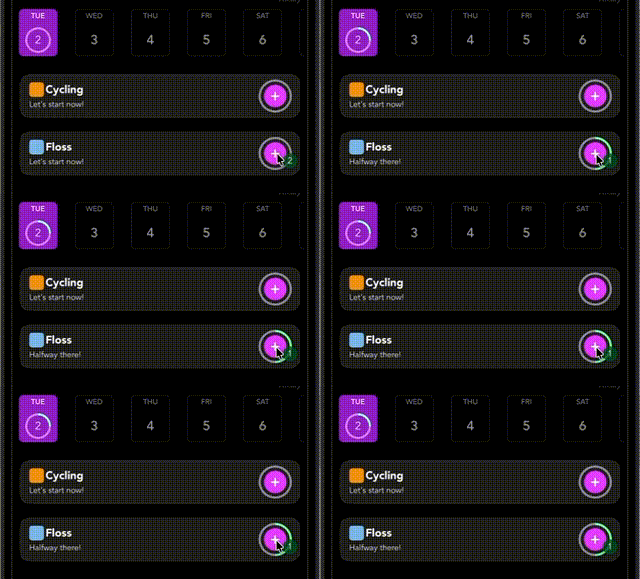
Even the smallest version of your habit counts.
If you’re curious how this works, check out our article explaining how HabitPath tracks both simple and countable habits.
A tiny win is still a win — and that’s the whole point.
How to Grow Your Micro-Habits (Without Forcing It)
People often worry that micro-habits are “too small.”
But the truth is: you grow naturally.
Here’s what actually happens:
- You start tiny.
- You build confidence.
- The habit feels easy.
- You organically do more.
- The habit grows without feeling forced.
And when life gets stressful?
You don’t collapse.
You simply fall back to your micro-habit, not all the way back to zero.
This is how lifelong consistency is built.
Final Thoughts: Start Small Enough That You Can’t Fail
Micro-habits and habit stacking aren’t just “tips.”
They’re a way of working with your brain instead of wrestling against it.
You don’t need more discipline.
You don’t need a motivational speech every morning.
You just need to make the starting line ridiculously low.
Start tiny.
Stack wisely.
Track your little wins.
Let consistency build itself.
The big results come later — but the tiny steps begin today.