The Dopamine Trap: Why Your Brain Craves the Plus Button (And How to Use It)
10 Jul 26, 00:00
The Dopamine Trap: Why Your Brain Craves Hitting the Plus Button
You know that little rush you get when you log progress on a goal?
That's not you just being productive.
That's dopamine. And it's the most powerful tool you're not using on purpose.
Here's the truth nobody tells you: motivation doesn't come before action. It comes after.
Your brain doesn't crave "success." It craves the hit—the tiny spike of dopamine that fires the second you complete something and see it register. That's why racking up a score feels good even when the task was tiny.
You're not lazy. You're not undisciplined. Your brain is just doing exactly what it evolved to do—chase the next visual win.
So stop fighting your brain. Start feeding it.
Why Willpower Was Never the Real Problem
Willpower is a finite resource. Dopamine is a renewable one.
You've been told your whole life that consistency comes from discipline. Grit your teeth. Push through. White-knuckle it.
That's exhausting. And it doesn't work long-term.
What actually works? Rigging the system so your brain wants to do the habit—because it knows a visual reward is coming immediately.
- Big, vague goals ("get healthy," "be more productive") give your brain nothing to reward.
- Small, specific actions ("drink one glass of water," "brush your teeth") give your brain an instant win.
The dopamine doesn't care how big the task was. It only cares that you tapped the button and logged the win.
That's the whole trick.
How to Hack the Dopamine Loop On Purpose
If racking up a visual score feels good, then the fix is simple: make it impossible for your brain to ignore your progress.
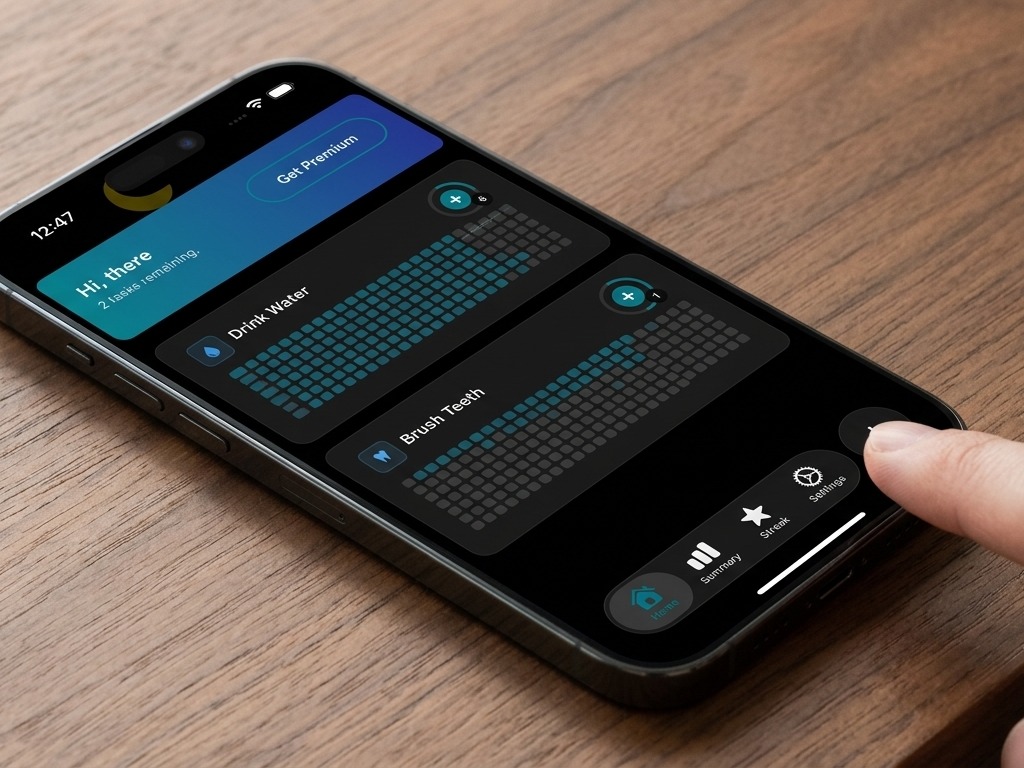
This is exactly why HabitPath uses a dynamic Grid Layout and a physical Plus (+) Button instead of a boring, old-school checkbox. Your brain needs different reward structures depending on the task, but it always demands to see the big picture.
Whether you are tracking a simple one-time habit like brushing your teeth, or a countable habit like drinking 8 glasses of water, you hit that Plus (+) Button to log it.
Every single tap instantly lights up your 7-day weekly grid.
- A simple habit needs that one satisfying tap to go from 0 to 1 and light up the square.
- A countable habit like water needs you to watch that number climb—1 of 8, 4 of 8, 8 of 8—ticking up your score while the grid fills in.
Seeing that progress map light up in real-time is an instant visual dopamine trigger. You can read the full breakdown of how HabitPath tracks both simple and countable habits if you want to see exactly how that distinction changes your odds of sticking with it.
Here's how to use this on purpose, starting today:
- Shrink the habit until it's stupid-easy. One pushup. One page. One minute. Small wins still fire the reward circuit.
- Make the "done" moment visual. Tapping that plus button and watching your grid squares light up gives your brain a concrete map of your success.
- Stack the reward immediately after the action. Don't wait. The closer the tap is to the actual behavior, the stronger the habit loop becomes.
- Protect the grid like it's sacred. Once your brain sees those squares lighting up day after day, breaking the pattern feels like a physical loss—and your brain hates losing more than it loves winning.
None of this requires more motivation. It requires better wiring.
Your Brain Doesn't Need You to Try Harder
It needs a system that rewards you for showing up.
That's it. That's the whole secret.
You don't need more discipline. You need to stop asking your brain to run on empty and start giving it what it's actually asking for—small, visible, immediate wins that light up your day.
Build the system. Let the dopamine do the rest.